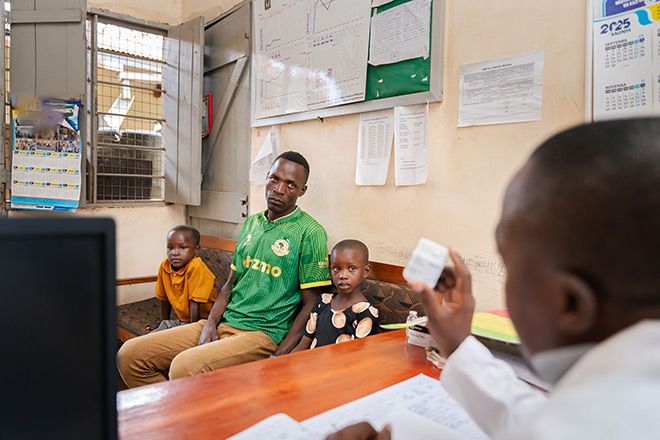
When it rains in Kabale, Tanzania, Angel Michael worries for her children.
Every splash through the rice field puddles carries risk of schistosomiasis, a disease transmitted through parasitic worms that can lead to anemia and stunting, threatening children’s ability to learn and grow.
“I wish we could stop children from contracting ‘kichocho,’” Angel said, using the local term for schistosomiasis. “It’s such a dangerous disease.”
For years, a suitable schistosomiasis treatment hasn’t existed for children under 5, despite their heightened vulnerability. This left an estimated 50 million preschool-aged children, mostly in sub-Saharan Africa, largely on their own to battle the disease.
But now, a new pediatric treatment option for schistosomiasis–developed by the Pediatric Praziquantel Consortium with assistance from the GHIT Fund–is ready to be rolled out. With support from the Japanese government, U.N. Development Program’s Access and Delivery Partnership (ADP) and others have kicked off distribution in Tanzania.
This progress was made possible by collaboration across borders and sectors. The effort spanned the globe–from Japan, where the pharmaceutical company Astellas helped spur research and development–to Brazil and Kenya, key manufacturing partners. Tanzania led on research and integration.
The pilot introduction of the new treatment, led by Tanzania’s National Institute for Medical Research, is under way in the rural Tanzanian districts of Sengerema, Kigoma, and Itilima–where Angel lives. Medicine supplied by Merck will reach more than 25,000 children.
Similar developments are taking place in Côte d’Ivoire, Ghana, Kenya, Senegal, Uganda and Zimbabwe in collaboration with the consortium and other partners. It is an extraordinary accomplishment in the fight against neglected tropical diseases (NTDs)–a collection of conditions, including schistosomiasis, that affect more than 1 billion people worldwide.
Last year, nine countries eliminated an NTD. Yet with mounting strain on global health systems, accelerating this progress requires new ways of working.
Japan stands out as a leader in innovative approaches to health and human security, as well as its commitment to universal health coverage.
With its approach to country-led partnerships for global health, based on mutual benefits and health sovereignty, the government has built a unique model for collaboration that has achieved significant advances in global health–particularly against schistosomiasis in Tanzania.
The strategy has three main elements:
Firstly, build on country leadership. For health initiatives to achieve success, they must reflect national needs and priorities, making country-led research and design essential.
Before launching arpraziquantel (arPZQ), the new schistosomiasis treatment option, Tanzania’s National Institute for Medical Research partnered with ADP on a community-led initiative that improves treatment awareness and empowers local advocates to increase the demand for arPZQ.
Secondly, leverage partner expertise. In Tanzania, one hurdle to rolling out arPZQ was securing approval from the country’s Medicines & Medical Devices Authority.
To speed up the process, ADP leveraged a technical protocol through the World Health Organization, which authorizes national regulators to evaluate drugs based on already-completed assessments by other, trusted agencies, helping to fast-track approval.
Thirdly, seek innovation and efficiencies in unusual places. In today’s constrained fiscal environment, breaking down silos and harmonizing health care delivery is essential.
In preparation for the arPZQ rollout, local and global partners, aiming to reduce program costs, folded arPZQ’s administration into existing NTD prevention and control programs.
By supporting sustainable integration of arPZQ into Tanzania’s national health care initiatives, the program will reach more children in a cost-effective manner and strengthen the wider health system.
The evolution of global health partnerships can expedite change. Breakthroughs in artificial intelligence also hold promise–reshaping health product development and diagnosis, and potentially cutting clinical trial times in half. While AI could transform NTD elimination efforts, its implementation must be both equitable and sustainable.
As the arPZQ rollout begins, millions of children–and their families and communities–stand to benefit. By building on Tanzania’s experience, other countries and partners can expand the reach of their NTD programs and make these diseases–which we can and must eliminate–a thing of the past.
About the authors:
Mandeep Dhaliwal is the director of UNDP’s HIV and Health Group, Bureau of Policy and Program Support. She brings to the organization more than 25 years of experience working on HIV, health, human rights, and evidence-based policy and programming in low- and middle-income countries. She joined UNDP in 2008 and was the architect of the Global Commission on HIV and the Law.
Dr. Osamu Kunii is CEO and executive director at the GHIT Fund. With his strong international experience working for multiple international organizations such as UNICEF and the Global Fund, coupled with his extensive interactions with other global organizations, he is interested in leveraging what he has learned and experienced to give back to Japan and Japanese organizations and lead innovations in global health.
link