


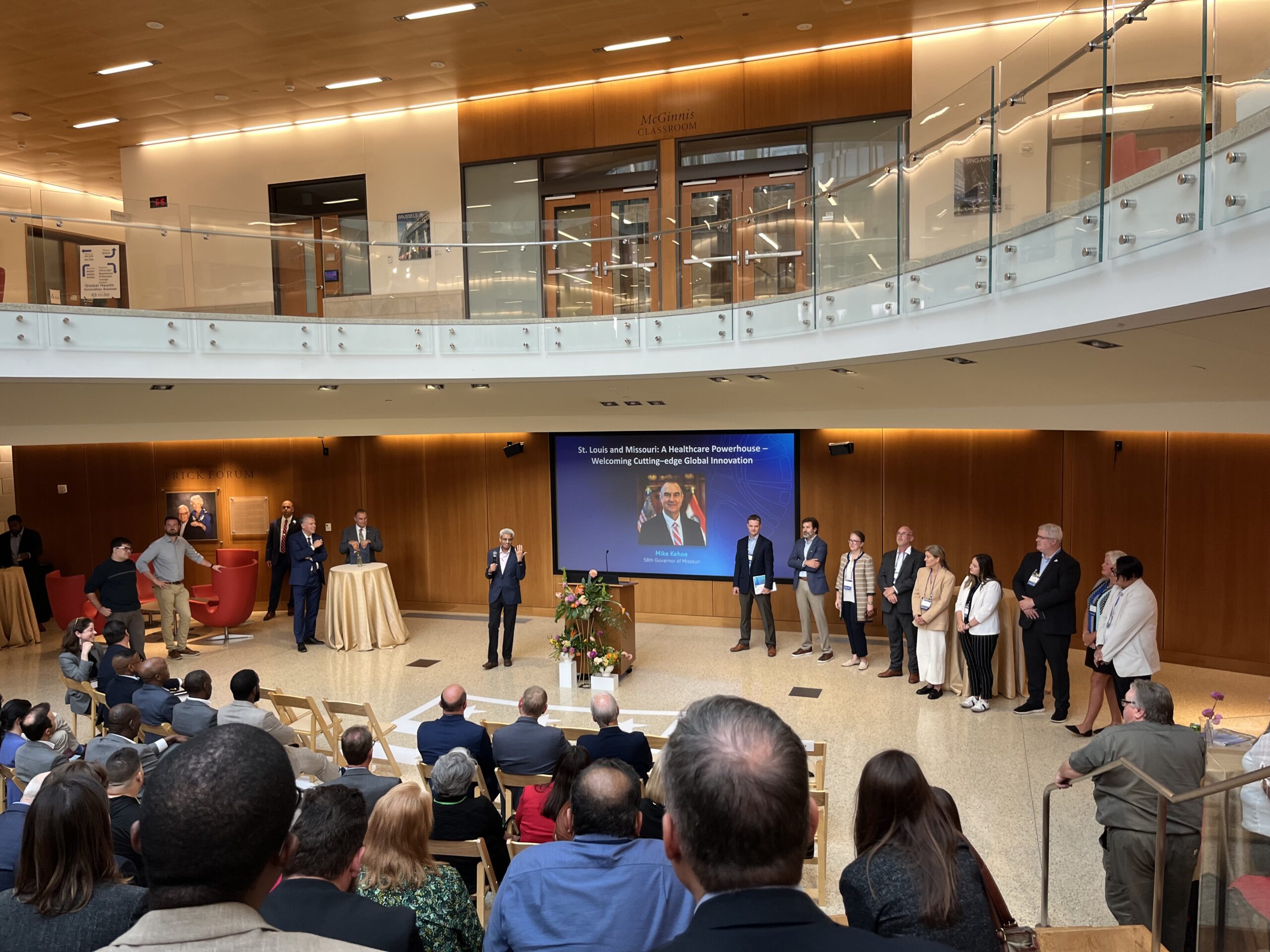
Missouri Governor Mike Kehoe spoke about the importance of providing effective rural healthcare and mental healthcare in Missouri, as well as the role that St. Louis plays in healthcare innovation, at the 9th annual Global Health Innovation Summit in WashU’s Knight Hall.
The summit was hosted by BioSTL, a St. Louis-based company that “fosters collaborative efforts to advance innovation & entrepreneurship,” according to its website. The summit was held on Aug. 28 and included 39 companies hailing from 10 countries, all developing healthcare innovations. The goal of the summit was to connect those companies with existing healthcare organizations like Barnes-Jewish Hospital and United Healthcare.
Vijay Chauhan, the global head of BioSTL, said in a speech to about 200 attendees that the companies were chosen based on their ability to solve pressing problems in healthcare.
“You all went from 1,000 companies that we looked at to 39 companies that earned the right to be in front of these [healthcare organizations],” Chauhan said. “Our goal is, after the meetings you have today, is to start your journey of partnership and impact.”
In his speech, Governor Kehoe emphasized the special role that WashU and St. Louis play in advancing healthcare innovation.


BioSTL Global Lead Vijay Chauhan Speaks at the 9th Annual BioSTL Health Innovation Summit
“You’re standing at a globally recognized healthcare institution, Washington University,” Kehoe told the audience. “Globally recognized leaders in certain categories all come from the Washington University system and continue to work with the Barnes-Jewish system.”
Kehoe also spoke about his goal of making Missouri a world leader in healthcare innovation.
“We have a new speed that we’re going to move at in the state of Missouri. And it’s from the movie ‘Spaceballs’ … that is ludicrous speed,” Kehoe said.
The governor’s speech also touched on specific healthcare needs of Missourians: for instance, the need to do more to improve rural healthcare in the state.
“The implementation of rural healthcare is really [where] things can happen [and] ideas can come from this summit, like I said, utilizing AI, utilizing some of the technology of the folks that I’ve just met,” Kehoe said.
Similarly, the governor talked about efforts to improve mental healthcare in Missouri.
“Mental health is the number-one issue that nobody wants to talk about. There’s nobody sitting in this room as a family member, including [my wife] and I, that hasn’t had somebody who’s faced some of these challenges,” Kehoe said. “We don’t talk about it enough, and we’ve got to get much better at that. We’re getting better.”
He emphasized that the Missouri government has put millions into funding a suicide hotline and behavioral crisis centers. Records also show the governor has used line item vetoes to cut millions in funding for other mental health initiatives, including some funding for a mental health and substance abuse center in Springfield.
One attendee, Matt Touch, is the Vice President of U.S. Sales & Marketing for Pulsenmore, a company developing an at-home ultrasound system. He explained to Student Life how it could help women dealing with pregnancy complications.
“Imagine it’s Thursday, and Mom doesn’t feel the baby move, and then it’s Friday, she doesn’t feel the baby move. She’s already a high-risk pregnancy, the clinic is closed, and she has limited options — after she speaks with the triage line, she might want to go to the ER for reassurance,” Touch said. “Well, now she can do a home ultrasound and check for fetal movement, fetal heart rate, and the doctor will review it in the cloud.”
Touch added that he was at the conference to make connections with people who are interested in using Pulsenmore’s home ultrasound system for pilot and clinical studies.
Another attendee, Michael Jordan, leads a BioSTL initiative to “accelerate the deployment and testing of AI solutions for under-resourced health organizations.”
“So [for] rural hospitals, federal clinics, urban community hospitals, we’re trying to provide resources and services to support resource-deprived health systems and deploy AI at scale,” Jordan said. “It’s a pretty big initiative, and we’ve been working hard to assemble a coalition of hospitals, innovators, policy makers, to make Missouri number-one in AI adoption.”
There were also several WashU students in attendance. Justin Strugger, a junior, said he attended in part because he had interned at BioSTL over the summer.
“It’s a pretty incredible opportunity to have global healthcare startups all connect right here in our business school,” Strugger said. “It’s been an incredible opportunity to see the purchasing power of St. Louis attract people from all across the globe.”
Editor’s Note: Matt Touch’s quote in this article was updated at 6:20 p.m. to clarify the function of the at home ultrasound device.
link