Demographics and background of NPM fellow participants
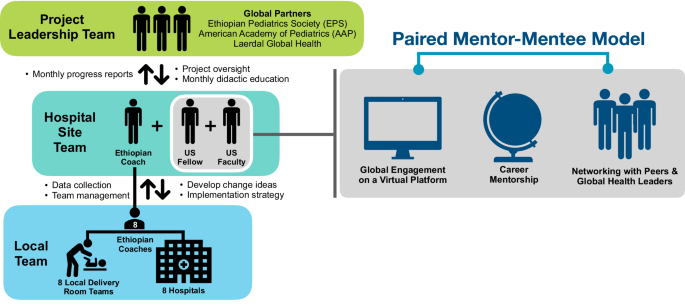
Eight NPM fellows participated in the EN-QI ECHO. Seven were identified as female, and one as male. They represented second- and third-year fellows from eight distinct US-based institutions.
All eight NPM fellows completed the pre- and post-program surveys. Six (75.0%) had prior global health training. This consisted of certificate programs (n = 3, 37.5%), formal or informal “global health tracks” in residency (n = 2, 25.0%), and master’s level training in global public health (n = 1, 12.5%). Two fellows (25.0%) felt that they had strong global health mentorship within their current NPM fellowship program, and five (62.5%) felt that they had such mentorship outside of their fellowship program. All five of these fellows commented that their global health mentors were from residency training.
Fellows were also asked to reflect on the time they had spent engaging in global health prior to the EN-QI ECHO and their associated depth of involvement in global health activities. Half of the fellows classified themselves as “advanced beginners” both for time and depth of past engagement. Only two (25.0%) fellows noted that they were “proficient” in regard to time spent in global health, and no fellows felt that they were “proficient” or “expert” in relation to global health involvement prior to the EN-QI ECHO. Definitions were created by faculty engaged in the EN-QI ECHO (Table 1).
Attendance at monthly virtual sessions
There were 12 monthly EN-QI ECHO sessions from February 2021 to January 2022. Attendance data were available from nine (75.0%) of these sessions. The average attendance rate amongst the NPM fellows was 40.3%, with a maximal attendance rate of 66.7%. Attendance at inpatient rounds at their home institution was the most common reason reported for lack of attendance at any given session.
Comfort with global health
Two questions appeared both on the pre- and post-program surveys. These questions assessed comfort working in a different cultural context and comfort working with research partners based in another country. Over the course of the EN-QI ECHO program, there was an increase from three (37.5%) to six (75.0%) fellows stating that they were very comfortable working in a cultural context other than their own. When asked about their comfort working with research partners in another country, one participant (12.5%) felt somewhat uncomfortable prior to the study; no participants felt very uncomfortable. Post-study, no participants felt uncomfortable. However, there was a slight shift towards being neutral (Pre: 0.0%, Post: 25.0%) rather than very or somewhat comfortable (Pre: 87.5%, Post: 75.0%). For all observations p > 0.05 and were not considered statistically significant.
Mentorship and program experience
In the post-program assessment, all respondents agreed or strongly agreed that they were able to form a meaningful connection with their US faculty mentor. The majority were either neutral or disagreed when asked if they were able to form a meaningful connection with their Ethiopian partner coach. Despite this, all participants agreed or strongly agreed that participation in this project was helpful to their career development and that the informal mentoring sessions with the US faculty were helpful (Table 2).
When asked to select from a predefined list and indicate what they gained by participating in the EN-QI ECHO project, “networking with other trainees and faculty in global health,” “exposure to the QI process,” and “experience working with international partners” were the most frequently selected. Networking was selected as the most important component by 50.0% of NPM fellow participants. Fellows also provided open-ended responses explaining why their selected choice was the most important (Table 3).
Focus group discussions on program experience
All fellows were invited to provide feedback on the program via post-program focus groups. Four fellows participated. Those who did not participate all cited an inability to make the scheduled focus group meeting time. Inductive codes were applied describing mentorship experience, networking, experience with the virtual ECHO platform, cross-country communication, project onboarding, and implementation. Following coding, three overarching or organizing themes emerged related to (1) career development, (2) cross-cultural partnership, and (3) areas for project improvement. Together, these organizing themes support a singular global theme: The EN-QI ECHO Program served as a successful model for fellow engagement in global health and can be further improved by enhanced focus on fellow onboarding and targeted mentorship throughout the program. Figure 2 illustrates the conceptual framework that emerged from the data.

EN-QI ECHO Ethiopian Newborn Quality Improvement Extension for Community Healthcare Outcomes.
Career development and the EN-QI ECHO initiative
All of the NPM fellows who participated in the post-program focus groups highlighted the value of the EN-QI program in their career development. Overwhelmingly, the benefit of the experience was reflected in the pairing of NPM fellows with SoNPM neonatologists with significant global health experience. Fellows noted how, when applying to be a fellow participant in the EN-QI ECHO, they looked forward to “being involved in an organization outside of my institution” (Participant 2) and “learning from leaders in our field” (Participant 4). By pairing each NPM fellow with a neonatologist, fellows had the opportunity to learn one-on-one from their mentor and witness how more experienced global health physicians navigated virtual partnerships. This was seen as especially important in the context of the COVID-19 pandemic. One fellow highlights this in her commentary:
“My biggest hope was really just to get to learn from the faculty leads … to learn from the Ethiopian coaches and learn about how to work together collaboratively on an international platform, virtually because I think we all got hit by this – I was supposed to spend a month every year of my fellowship in [a global setting], working on my quality improvement projects, and it became impossible, because of COVID.”(Participant 4)
Fellows commented on the value of seeing their mentor work with the AAP, EPS, and local team to navigate project-specific challenges, programmatic delays, and data management questions that arose throughout the study. They also noted the importance of witnessing a good mentoring relationship that valued the role and the experience of the Ethiopian coaches.
“I think it was nice to get to watch other people navigate those challenges and glean some little pearls about how to adjust projects that I’m going to work on in the future.” (Participant 2)
“It was really helpful for me just to kind of see that model of how to be a good mentor, how to work on a project collaboratively to be able to support [the Ethiopian coaches] without being overbearing and having too much control.” (Participant 4)
Because the project fellows and neonatologists came from a wide range of US academic institutions, engaging fellows in the EN-QI ECHO also allowed for valuable networking. Some mentor-mentee dyads were able to meet in person to further strengthen their mentoring relationship. As one fellow described, “The incredible thing was during this I was able to meet up with my mentor in person at PAS [Pediatric Academic Societies] and go to one of the talks they were doing about global health.” (Participant 2) Outside of their one-on-one pairings, the fellows appreciated the opportunity to engage with all of the US-based neonatologists in a series of informal career-focused “coffee chats”. These allowed time for fellows to hear about career journeys and ask specific questions about launching a career in neonatal global health.
“They had a group of the mentors come in and kind of just chat about career, about life balance, and different directions that they could go with their projects that they were doing outside of this work. It gave access to a lot more people [faculty] in the group and the additional advice that came through that.” (Participant 3)
Another key element of their personal growth and career development was the community the fellows felt amongst their NPM fellow peers. Fellows described how valuable it was to simultaneously learn from their mentors and to meet fellows who were also learning to be global health researchers. This helped them build a community that would “go beyond this project” (Participant 1).
Cross-cultural partnership
The second organizing theme identified by our fellow focus group was how the cross-cultural partnership between the US and Ethiopia was a key strength of the study but was not without challenges. Several of the focus group participants highlighted how participating in EN-QI ECHO allowed them to engage with partners in LMICs despite not being able to travel: “I think it was a great creative way to say, ‘how can we continue with ongoing education without physically being in the country?’” (Participant 4)
Others viewed the virtual platform as a novel way to connect partners in a more individual way that has distinct value from the large group settings. As one fellow noted, “Our one-on-one sessions (WhatsApp video calls) were really helpful, because it allowed us the opportunity to meet directly, see their setting, … and really talk about ‘what are the challenges in your unit? Where are your gaps? How do we address this?’” (Participant 1). Importantly, the EN-QI Project took place during the COVID-19 pandemic. Fellows praised how a virtual global health project allowed them to continue working in the neonatal global health space, supporting partners in the group, while not being able to travel. One fellow reflected, “I [the virtual platform for EN-QI ECHO] increased my interest in the project because I think we all felt stuck, I mean, as [fellows] who are trying to do global health work and are not able to be in the places where the research is happening.” (Participant 4)
Remote partnership also had its limitations. Most notably, the fellows described feeling unaware of what was happening on the ground between meetings and thus were not sure how to assist, stating “I wasn’t always sure what they needed from me for the project between the sessions.” (Participant 2) Lastly, fellows felt that the virtual nature of the project limited engagement due to logistic and technical constraints. Fellows cited “getting everybody to get on the zoom on time, connection errors, people, and not muting themselves” (Participant 2). At the same time, witnessing how their neonatologist mentors navigated these challenges was helpful to the fellows, giving them the realization that “So this happens to all of us” (Participant 4).
Program gaps
While the fellows uniformly affirmed the strengths of the EN-QI ECHO Initiative, when reflecting on the program as an avenue for fellow global health engagement, the participating fellows identified gaps in communication and organization that limited the full potential of program participation for fellows. First, a few participants stated that the role of a fellow “wasn’t well delineated” (Participant 3). Fellows felt like they were functioning both as teachers and mentees but were not clear on how much of a leadership role to take in the program: “How do I help other people across the world, with all of these barriers, accomplish a QI project when I myself am learning?” (Participant 1)
Similarly, fellows noted that their paired mentors focused on the fellow’s career development goals rather than how the fellow should contribute to the EN-QI ECHO. One fellow stated, “I do think that the mentors tried to say, like, what are your career goals? … I think this was lovely and one of the things I wanted from this, but I don’t think that that was within the direct scope of the project in terms of being a QI project in hospital sites and Ethiopia.” (Participant 2)
Lastly, fellows expressed a desire to be more integrated into project planning discussions. For example, one fellow shared that they were not sure how delayed cord clamping was selected as the focus of EN-QI ECHO, noting that “in meeting directly with our Ethiopian coach he you know, at the beginning of the project we had actually identified a slightly different gap that we wanted to focus on” (Participant 2). Interestingly, another fellow responded with clarifying understanding, paraphrasing the alignment of QI projects between sites as “let’s get everybody on board with the same project, so that we can have a successful project … and see some change and walk everybody through the QI process, and at least you’ll learn from each other in the process.” (Participant 3)
link